Computer Vision Belongs in the Warehouse, Not the Demo
Most AI attention goes to knowledge work. The larger, slower prize is in industries that move physical objects.

Most AI attention and most AI capital have gone to knowledge work, where the input is already text and the output is already a document. The larger and slower prize is in industries that move physical objects: logistics, moving, construction, repair, field service, warehousing. They share one weakness, and it is not a shortage of models. It is that the information needed to plan a job is collected manually, late, and inconsistently.
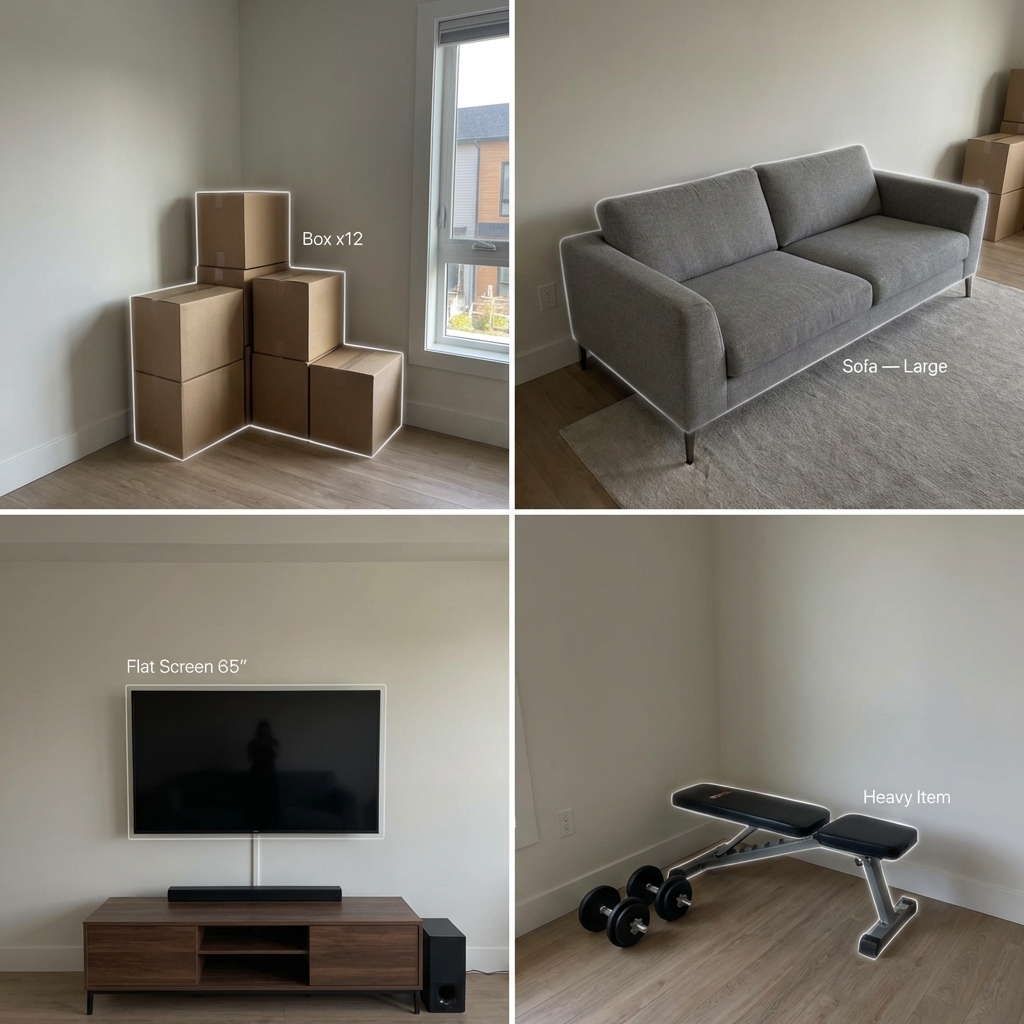
MoovVision works in one of those industries. A household or office move is quoted from a phone conversation or a rushed walkthrough, planned from a list somebody typed, and executed by a crew who discover on the day that there are four more rooms of contents than anyone recorded.
Capture is the bottleneck
Ask any operator where the money leaks and the answer is upstream. An inaccurate inventory produces an inaccurate quote, the wrong vehicle, the wrong crew size and an argument at the end. A missing photograph produces a damage dispute nobody can resolve. A job described in free text cannot be scheduled by software, priced consistently, or compared with the job before it.
Automating capture — walking a space with a camera and producing a structured, itemised, timestamped record — fixes the input. Everything downstream then becomes tractable: quoting against real volume, scheduling against real hours, crew and vehicle allocation, insurance declaration, and dispute resolution against a record made before the van arrived.
The model is rarely the hard part. Getting clean input from a real environment is.
The field is not a demo
Systems in this category fail on conditions, not on accuracy benchmarks. Rooms are dim or backlit. Objects are stacked, wrapped and half-occluded. Lenses are smudged. Connectivity drops between floors and in basements. The person holding the phone is a working crew member with four minutes, not a careful operator following a script.
That imposes unglamorous requirements: capture that works offline and syncs later, tolerance for partial and repeated scans, graceful degradation to a human-reviewable list rather than a confident wrong answer, and a workflow that takes less time than the clipboard it replaces. A system that only performs in a showroom does not perform.
Adoption follows a cost, not a vision
Operators in physical industries run thin margins and long days. They adopt tools that remove a specific, visible cost this quarter — fewer failed quotes, fewer damage claims, one less person doing surveys — and they abandon anything that requires a change of culture before it delivers value. The correct sequencing is to solve one expensive step completely, prove it in the operator's own numbers, and expand from there.
That is also why the durable opportunities here are slower than they look. The technology is ready before the workflows are, and the work of changing a workflow is done in depots and on doorsteps rather than in a model.
MoovVision
A Nova Capital Holdings group company.
Related news
 Feb 11, 2026
MoovVision Uses AI to Rethink the Home Moving Experience
Computer vision applied to a physical service industry — scanning a home, understanding what is in it, and planning the move around that.
Read Article
Digital Sampling and the End of the Wasted Prototype
How 3D development tools are changing the economics of small-batch design.
Read Article Sep 12, 2026
Interned Is Building the Route From Campus to First Job in Africa
A placement platform matching college students across the continent with real internship opportunities.
Read Article