Sport, Data and the African Talent Pipeline
Two group businesses approach African sport from different ends: one measures, the other represents. The pipeline needs both.
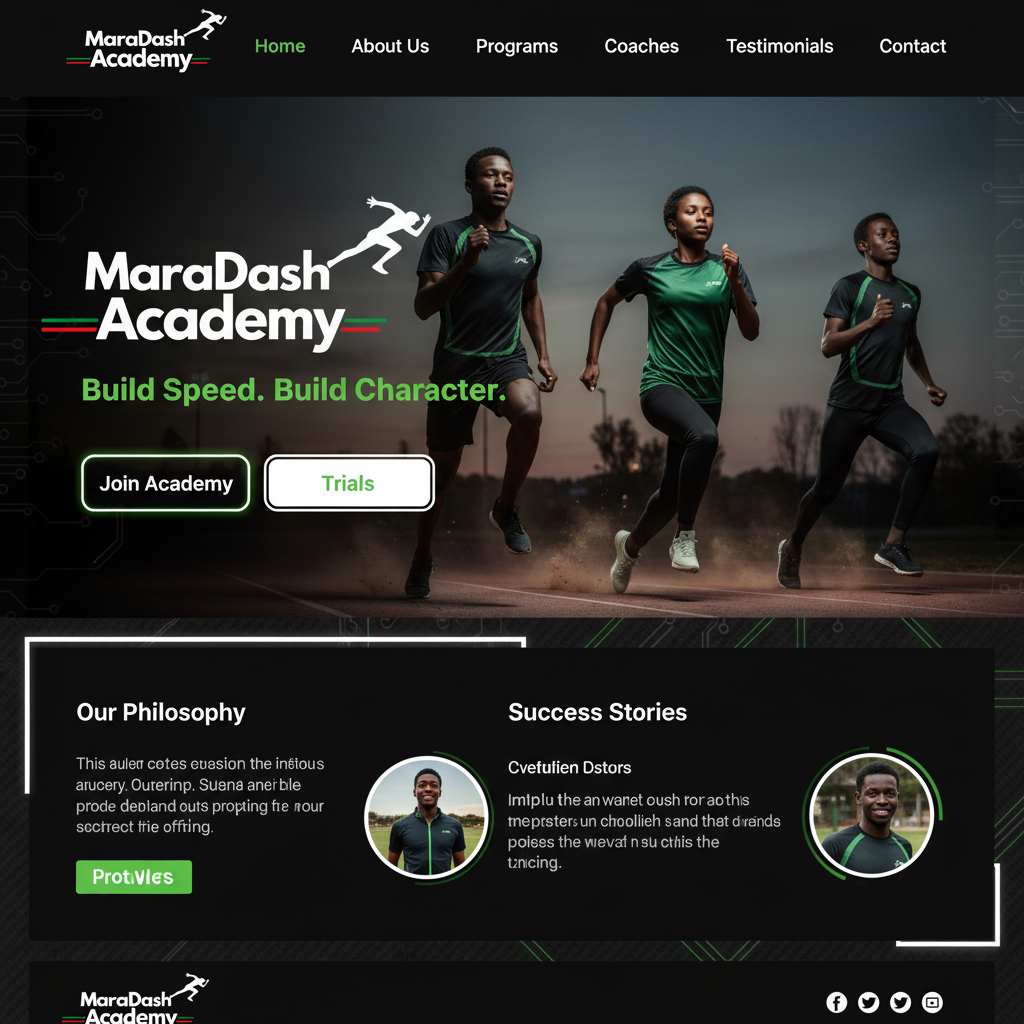
Two group businesses approach African sport from opposite ends. Prospex Vision measures; MaraDash develops and represents. The talent pipeline needs both, and it currently has too little of either.
The pipeline fails at the handoffs
Athlete development rarely fails because talent is absent. It fails at transitions — school to academy, academy to club, club to national selection, domestic to international. Each handoff is a manual process run by whoever is available: a coach's recommendation, a trial someone heard about, a scout in the right stand on the right afternoon. Every transition loses information, and with the information it loses athletes who were never seen, or who were seen on a bad day.
Continuity of record
A continuous, verified record — physical development, training load, competition results in context, injury and recovery history — follows an athlete through those transitions and reduces the dependence on chance observation. For a young athlete in a country with limited scouting coverage, that record is often the only asset that can travel ahead of them.
It also protects them. A record that shows an athlete's actual training age and load history is the best available defence against the two most common harms in developing pipelines: overtraining a promising fifteen-year-old, and misrepresenting an athlete's age or history to a foreign club.
Sport is a data industry that has not yet organised its data.
Representation as infrastructure
Measurement alone produces well-documented athletes with no one advocating for them. Representation supplies the other half — education alongside training, medical advocacy, financial literacy, contract terms written for a fifteen-year career rather than a single transfer fee, and someone whose job is to say no to a bad offer.
Where the two halves connect, the athlete negotiates from evidence and is advised by people who are paid to think past the next window. Where they do not, the athlete is dependent on whoever found them.
Why it should be built here
Both halves are more valuable when built on the continent by people who understand its specifics: federation structures and their funding, school calendars that interrupt training blocks, altitude and climate, the realities of travel for competition, and family obligations that shape what a young athlete can commit to. Systems designed for European academies assume infrastructure, continuity and money that are simply not present, and they fail in ways their designers never see.
The commercial opportunity follows the same logic. African sport exports talent and imports almost all of its technology and representation. Building the measurement and advocacy layers locally keeps more of that value — and more of the athletes' careers — connected to the clubs, schools and communities that produced them.
Related news

Who Owns an Athlete's Data?
Performance data is becoming a career asset. The question of control is unresolved.
Read ArticleNov 14, 2025MaraDash and the Next Generation of African Sporting Talent
Representation, development and global exposure for African athletes.
Read Article Sep 9, 2026
Hello Kenya: Mindset Training Built on Science, Delivered Through Technology
Personalised sport psychology for athletes at every level, developed with coaches and practitioners.
Read Article