What Citizens Are Actually Pledging — and Why It Is Written This Way
A pledge is only as good as its wording. This one was written to be specific enough to hold someone to, and short enough to be remembered without reading it again.
Most civic declarations fail for the same two reasons. They are too abstract to act on — peace, unity, prosperity — or too long to be recalled by the person who signed them. The African Citizen's Pledge was drafted against both failures: every clause describes behaviour a single person can perform this week, without money, permission or office.
Integrity in ordinary transactions
The first commitment is the one most often treated as unavoidable: to neither pay nor accept a bribe. This is deliberately placed at the front, because petty corruption is where most citizens meet the problem — a licence, a road stop, a school place, a hospital queue. It is also the one place where individual refusal has an immediate, compounding effect, and the one most people privately believe cannot be changed.
The pledge does not pretend refusal is costless. It asks for it anyway, and asks it publicly, so that the person refusing knows others have made the same undertaking.
Responsibility for one's own community
The second set of commitments concerns the immediate environment: the street, the school, the clinic, the water point. To keep it clean, to protect shared property, to look after those who cannot look after themselves, and to take part in the meetings where local decisions are made. Nothing here waits on government.
A resilient, ethical and united continent is built by citizens, one commitment at a time.
Fellowship across borders
The third commitment is the hardest to keep and the reason the pledge is continental rather than national. It asks citizens to treat other Africans — of any nationality, ethnicity, language or faith — as compatriots rather than competitors, and to refuse the xenophobia and ethnic arithmetic that have cost the continent more than any external force in living memory.
Service and contribution
The fourth asks for something from those who have more capacity: to mentor, to teach, to hire fairly, to pay suppliers and workers on time, and to use position for service rather than extraction. Professionals and business owners carry the greater part of this clause, which is intentional.
The objections, taken seriously
Two criticisms are worth stating plainly. The first is that pledges are cheap — that signing is a substitute for acting, and a public record of signatures is an archive of good intentions. The project's answer is structural rather than rhetorical: the pledge is renewable rather than permanent, it links to specific local actions, and it makes no claim to have achieved anything by itself.
The second is that ordinary citizens are being asked to compensate for institutional failure. That is a fair objection. The response is that institutions are staffed by citizens, and that no reform of a public office survives contact with a population that considers the rules optional.
How it is meant to be used
Individually, it takes a minute. Beyond that, the pledge is written to be taken collectively — by a class, a team, a congregation, a staff room, a village committee — read aloud, and displayed afterwards where the people who took it will see it. It is free to reproduce: printed, painted on a wall, or read at an assembly. No permission is required and no organisation owns the words.
That is the test the project has set itself. A pledge that only exists on a website has not left the building.
AfricaPledge.org
A Nova Capital Holdings group company.
Related news
 Sep 8, 2026
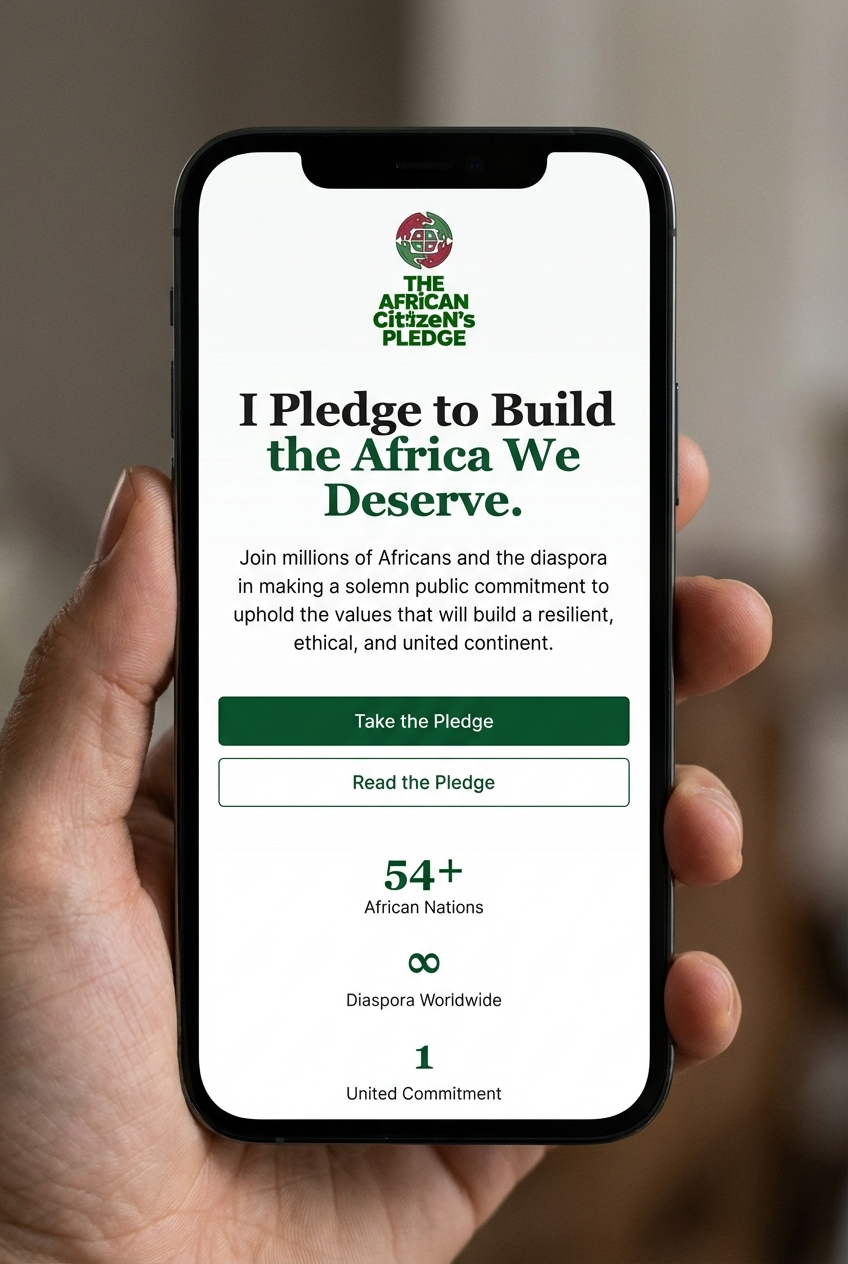
AfricaPledge: A Public Promise to Build the Africa We Deserve
The African Citizen's Pledge invites citizens and the diaspora to make a solemn public commitment.
Read Article
Inclusive Design Is Just Good Product Design
What building for sensory difference teaches teams about building for everyone.
Read Article
Community Work Measured the Same Way as Business
How the group approaches impact initiatives without turning them into marketing.
Read Article